
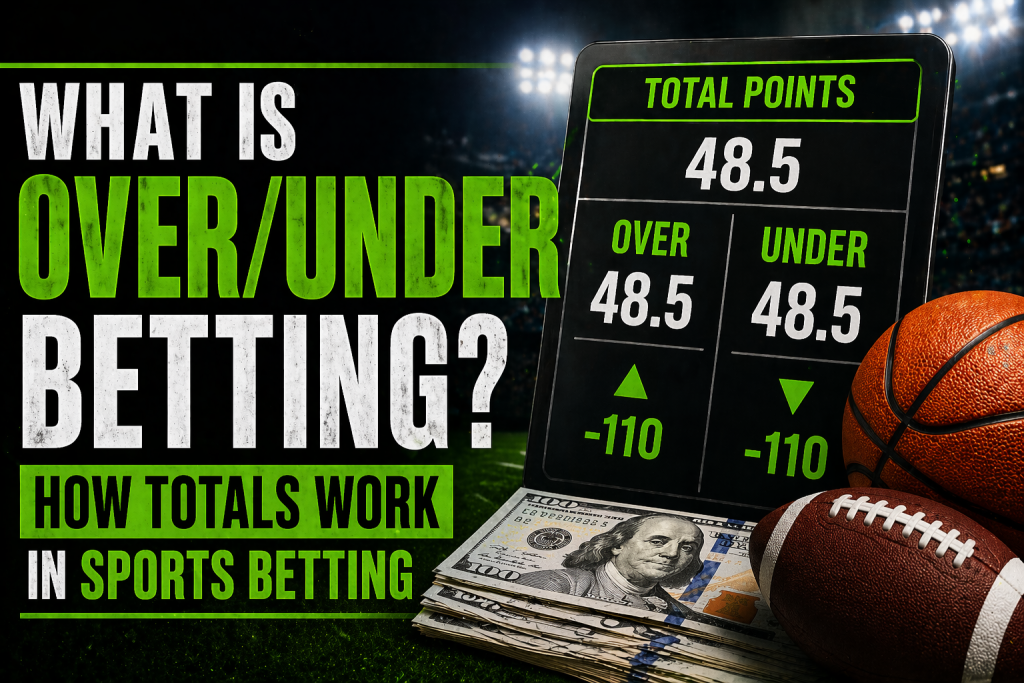
The quick answer: Over/under betting — also called totals betting — means wagering on whether the combined score of both teams will be higher or lower than a number set by the sportsbook. You don’t pick who wins. You predict whether the game will be high-scoring or low-scoring.
Over/under betting is one of the most beginner-friendly wagers in sports. No spreads, no picking a winner — you’re simply deciding whether a game will have a lot of scoring or a little. Here’s exactly how it works across every major sport.
How an Over/Under Bet Works
The sportsbook sets a number representing the expected total combined score of a game. You bet on whether the actual combined score will be over or under that number.
227 > 224.5 so the over wins in example one. 213 < 224.5 so the under wins in example two. It doesn’t matter who won the game — only the combined final score counts.
Why the Half Point?
Totals often include a half-point — 224.5 instead of 224 — to eliminate the possibility of a push (a tie where bets are refunded). If the combined score lands exactly on the total with no half-point, all bets are returned. The half-point forces a clean winner every time.
What Are the Odds on Over/Under Bets?
Just like spread bets, totals are typically priced at -110 on both sides. You bet $110 to win $100, or scale any amount proportionally. Occasionally you’ll see the pricing skewed — for example -115 over / -105 under — which signals that heavy public money is flowing toward the over and the book has adjusted the price to balance action.
Over/Under Across Different Sports
NFL Football
Totals typically range 37–55 points. Weather, game pace, and defensive matchups all matter. Cold windy weather consistently suppresses scoring and pushes totals lower.
NBA Basketball
Totals typically range 210–240 points. Pace of play — how many possessions per game — is the biggest driver. Back-to-back games and rest advantages factor in significantly.
MLB Baseball
Totals usually range 7–10.5 runs. Starting pitchers are the single biggest factor — ace matchups drive unders. Ballpark dimensions also matter; some parks play dramatically higher than others.
NHL Hockey
Totals are very low — usually 5–6.5 goals. Goaltender matchups are crucial. Even the best teams in hockey frequently finish games under the total given how low-scoring the sport is.
How Totals Are Set
Oddsmakers consider multiple factors when setting a total:
- Offensive and defensive rankings of both teams
- Starting pitcher or quarterback matchup — a dominant starter can take several points off the total alone
- Pace of play — fast-paced teams playing each other push totals up
- Injuries to key offensive players — a missing star scorer meaningfully lowers the expected total
- Weather — wind and cold temperatures suppress scoring in outdoor sports
- Rest and travel factors — fatigued teams tend to score fewer points
Just like point spreads, totals move as bets come in. If money floods onto the over, the line moves up to attract under bettors and balance the book. Tracking line movement is one way experienced bettors identify where sharp (professional) money is going.
A Concrete NFL Example
You bet the Over: you need the combined score to be 47 or more.
You bet the Under: you need the combined score to be 46 or fewer.
Final score: Chiefs 28, Raiders 24 — Combined: 52. Over wins.
Final score: Chiefs 20, Raiders 17 — Combined: 37. Under wins.
Final score: Chiefs 28, Raiders 17 — Combined: 45. Under wins. The Chiefs won easily but the under still cashed because the total was 45, under the 46.5 line.
Player Prop Totals
The same over/under concept applies to individual player props — and this is where DFS bettors find the most overlap with their existing research:
- Patrick Mahomes over/under 275.5 passing yards
- Nikola Jokic over/under 27.5 points
- Shohei Ohtani over/under 7.5 strikeouts
- Stephen Curry over/under 4.5 three-pointers made
The same research you already do for DFS lineups — checking matchups, snap counts, targets, usage rates, pitcher handedness — applies directly to player prop totals. If you can project a player’s performance, you can evaluate whether the sportsbook’s line is set correctly.
Why Totals Bettors Love Over/Unders
You don’t need to care who wins. If you bet the over, you’re rooting for scoring by both teams regardless of which side they’re on. A blowout is fine as long as the winner ran up the score. A close game is fine as long as both teams kept scoring. This makes over/under betting uniquely enjoyable — you’re always involved for the full game no matter the score.
Common Mistakes With Totals Betting
- Ignoring the starting pitcher or quarterback — a backup QB or a weak pitching matchup changes the expected scoring dramatically. Always check before betting
- Betting overs blindly because they’re more exciting — the public loves overs. Books know this and shade totals slightly high to exploit that bias. Unders are often undervalued
- Not checking weather — a 20 mph wind in a December NFL game can take 6–8 points off the expected total. Always check weather for outdoor games before betting
- Overlooking pace of play — a fast-paced NBA team against a slow-paced defense creates a very different total than two fast-paced teams playing each other
- Not shopping the line — one book might have a game at 46.5 while another shows 47. That half-point can be the difference between winning and pushing
Sharps lean under: Professional bettors historically bet unders at a higher rate than the general public. The public loves action and tends to root for scoring — which pushes totals slightly higher than they should be. This doesn’t mean always bet unders, but it’s worth noting when evaluating a total that feels a touch inflated.
Game flow warning: Live totals (betting the over or under after the game starts) can move dramatically based on early scoring pace. A game that starts with two quick touchdowns may see the live total surge well above the opening number. Be careful chasing live overs after big early scores — regression to the mean is real.
Key Takeaways
- Over/under = bet on whether combined scoring is higher or lower than the sportsbook’s number
- You don’t pick a winner — only the combined final score matters
- -110 is the standard price on both sides
- Half-point totals eliminate the possibility of a push
- Starting pitcher/QB and weather are the two biggest line-movers to watch
- Always shop the total across multiple sportsbooks — half-points matter
- The same research you do for DFS applies directly to player prop totals
Claim your bonus before you play
New-player offers from the sportsbooks available in your state.

Bet $20, Get $100 in Bonus Bets Instantly
Promo code: WINGATASB

Gambling Problem? Call 1-800-GAMBLER. 21+ and physically present in New Jersey or Pennsylvania. New customers only. Deposit $20+ and place a $20+ first bet to receive $100 in Bonus Bets. Bonus Bets expire in 7 days; stake not returned. One new customer offer only. Additional terms apply.

New DraftKings Sportsbook Customers Spend $5 Get $200 in Bonus Bets (Paid Over 21 Days) + 3 Months of NBA League Pass On Us
Promo code: WINDAILY

GAMBLING PROBLEM? CALL 1-800-GAMBLER or 1-800-MY-RESET, (800) 327-5050 or visit gamblinghelplinema.org (MA). Please Gamble Responsibly. 888-789-7777/visit ccpg.org (CT), or visit www.mdgamblinghelp.org (MD), 1-800-981-0023 (PR). 21+ and present in most states. (18+ DC/NH/PR/WY). Void in CAN. Eligibility restrictions apply. On behalf of Boot Hill Casino (KS). Pass-thru of per wager tax may apply in IL. 1 per new Sportsbook customer. $5+ first-time bet req. Max. $200 issued as non-withdrawable Bonus Bets. Stake removed from payout. Reward issued as $50 in Bonus Bets every 7 days via click-to-claim for 21 days. Bonus Bets and click-to-claims expire 7 days (168hrs) after issuance. Terms: dkng.co/offer. Get 1 promo code to redeem a 3-month NBA League Pass subscription, complimentary of DraftKings. Subscription auto-renews monthly at then-current price (currently $16.99/mo); cancel anytime. Terms, restrictions, and eligibility requirements apply. Redeem League Pass by 12/19/26 at 11:59 PM ET. Addt’l terms: support.watch.nba.com/hc/en-us/articles/9165532876183-League-Pass-Terms-of-Use_. Ends 11/29/26 at 11:59 PM ET. Sponsored by DK.

Get $200 in Bonus Bets when you wager $5 for 4 days
Promo code: WDS

Gambling Problem? Call 1-800-GAMBLER or visit RG-help.com. Call 1-888-789-7777 or visit ccpg.org/chat (CT). Hope is here. GamblingHelpLineMA.org or call (800) 327-5050 for 24/7 support (MA). Visit www.mdgamblinghelp.org (MD).

Get a 20% Deposit Match up to $1,600 in Sports Bonus!
Promo code: WINDAILYSB

Gambling problem? Call 1-800-GAMBLER or 1-800-MY-RESET (Available in the US) 877-8-HOPENY or text HOPENY (467369) (NY) 1-800-327-5050 (MA), 1-800-BETS-OFF (IA), 1-800-981-0023 (PR) 21+ only. Please Gamble Responsibly. See BetMGM.com for Terms. First Bet Offer for new customers only (if applicable). Subject to eligibility requirements.

Up to $1,000 in FanCash Matched Bets (100% bet match up to $100 in FanCash for 10 days)
Promo code: windaily

Gambling Problem? Call 1-800-GAMBLER or visit RG-help.com. Call 1-888-789-7777 or visit ccpg.org/chat (CT). Hope is here. GamblingHelpLineMA.org or call (800) 327-5050 for 24/7 support (MA). Visit www.mdgamblinghelp.org (MD).

Bet $5 and Get Up to $500 in No Sweat Bets
Promo code: WINDAILY

Gambling Problem? Call 1-800-GAMBLER. To be eligible, the Player must be at least 21 years old, physically located in an Eligible Jurisdiction: MI and NJ, and not on any exclusionary lists in any Eligible Jurisdiction. Excluded patrons are prohibited from participating in Promotions. To be eligible all personal and contact data associated to your account must be verifiable.
21+ (18+ where permitted) and present in an eligible state. Terms apply. Gambling problem? Call 1-800-GAMBLER or 1-800-MY-RESET.


